Download here: https://canva.link/517c976jcplw48
Author: hoophugs313
-
Phonemic Awareness
What is phonemic awareness?
Phonemic awareness is the ability to hear, recognize, and identify the individual sounds that make up a spoken word. You can start working on your child’s phonemic awareness before he or she starts reading or even knows the alphabet.
Activity #1: Segmenting Sounds
- Say the word.
- Next, say the individual sounds in the word. Hold up a finger for each sound.
Here is a video demonstrating this strategy: Counting Phonemes in Words
Activity #2: Isolating Sounds
- Say a word. Ex: cat
- Ask questions like, “What sound did I make first,” or “What sound is at the beginning of the word?” You can also ask about middle and ending sounds
Activity #3: Blending Sounds
- Say the 3 sounds in “cat.”
- Ask your child what word you just made. If this is tricky for the child, you can demonstrate how to put the sounds together as a word. I’ve also had good luck asking kids to “sing” the sounds in order to blend them.
Activity #4: Manipulating Sounds
- Say the word cat.
- Ask your child, “If I take away the /c/ sound and trade it for the /b/ sound, what new word would I make?”
Matching Sounds and Letters
The ability to match a sound to the correct letter is crucial for accurate spelling and accurate decoding.You may notice that your child has a harder time matching vowel sounds to the correct letter than they do matching consonant sounds to the correct letter. This is very common. My theory is that consonants are easier because, for most consonants, we say the sound the letter makes when we say the actual name of the letter. Vowels, on the other hand, not only sound very similar to each other but also have multiple sounds and multiple spelling patterns.
Sound boxes and vowel sorts are my two favorite activities for matching sounds to letters. If you are unfamiliar with sound boxes you can learn about them here: How to Improve Spelling-Sound Box Strategy for Beginning and Struggling Spellers – The Vowel Coach
Vowel Sorts
Vowel sorts help kids zero in on vowel sounds and make informed choices when spelling. We want kids to think about questions like:
- Which vowel do I hear?
- Is the vowel making its long sound, short sound, bossy R sound, or something else?
- If the vowel is long, do I need to choose a long vowel spelling pattern?
If you need extra resources for working on those tricky vowels, you can check out my vowel sorting packet here: https://thevowelcoach.com/product/vowel-sorting-activities/
Reading vs. Spelling
I like to tell my students that reading is looking at the letters and saying the sounds, but spelling is listening to the sounds and writing down the letters that make those sounds. Reading and spelling are literacy partners, and it is important to spend time working on both.
Check out my pre-reading unit here: https://thevowelcoach.com/product/pre-reading-skills/https://thevowelcoach.com/product/pre-reading-skills/
-
How to Talk to Your Kids About I.C.E.
Here are two podcast episodes with tips on how to talk to your kids about I.C.E.:
Care and Feeding:
What Fresh Hell Parenting Podcast:
https://www.whatfreshhellpodcast.com/how-do-we-talk-about-whats-happening-in-minnesota-with-erin-cox
-
Individualized Education Program (IEP)
Every child deserves an academic environment that supports his or her needs. Identifying and addressing potential issues early is in your child’s best interest.
Let’s say your kid’s teacher suggests an IEP. Are you the type of parents who feels relieved that a teacher is picking up on potential issues and getting the support ball rolling, or are you the type of parent that feels anxious, angry, or flat out insulted? Both reactions stem from the same place: a sense of love and protection for your child.
Whatever your initial reaction is, I beg you consider an IEP as gift to your child’s future. The word “Individualized” in the program title is key. This is not a one size fits all situation. The ultimate goal is to provide your child support in the least restrictive learning environment.
By the way, parents can request an IEP from the school even if the teacher has not. If you have concerns about your child’s academic or behavioral development, please talk to to your child’s teacher early in the school year. Continue to advocate for your child. The first month or two of school is usually exceedingly overwhelming for everyone, so if you haven’t heard anything by mid October, ask again.
Understanding the IEP Process:
I highly recommend that parents visit Understood.org to learn more about what an IEP is. Here is a helpful link: https://www.understood.org/en/articles/what-is-an-iep
Podcasts:
- Understood Explains
In addition to the website, Understood.org has an excellent podcast called Understood Explains. Season 3 explores the IEP process and has a lot of useful information for parents. Here is the link:
https://www.understood.org/en/podcasts/understood-explains-ieps
2. Opportunity Gap
Another podcast from Understood.org I’d like to recommend is called “Opportunity Gap.” Here you will find episodes about a variety of childhood topics including learning disabilities, ADHD, anxiety, reading skills and more. It also includes the Understood Explains IEP episodes.
https://www.understood.org/en/podcasts/the-opportunity-gap
3. Tilt Parenting
This podcast is for people who parent and care for neurodivergent kids.
https://tiltparenting.com/podcast-about-children-with-learning-disabilities
-
Magic E: Song and Story Links
Magic E Song:
a-e Song:
a-e Story:
e-e Song:
I do not have an e-e story.
i-e Song:
i-e Story:
o-e Song:
o-e Story:
u-e Song
u-e Story
-
Let’s Talk About Math
As a child in the 80’s I received what I now consider to be very surface level math instruction. I learned the rules. I followed the rules. The rules worked. The end.
With this surface level training, I managed to successfully earn a high school diploma and a college degree without ever having to think about why I carried a one when I was adding or why a 2 became a 12 when I borrowed. I did not enjoy math or think it was fun, but I survived.
I became a parent in 2003. Throughout the aughts and 2010’s parents like me were losing their minds over “new math.” It’s not that math itself changed. The answer to 10+10 will always be 20. It was how math was being taught that went through an evolution. Instead of kids being expected to learn and execute the rules, they were expected to understand why the rules were the rules in the first place. They were also learning to break numbers apart and put them back together in ways mom and dad had never seen before. A common parental chorus was, “We had one way and it worked. Why fix something that isn’t broken?”
I’ve come to believe it was broken, but I’ll save that discussion for another day.
Fast Forward to 2025, and parents who missed out on “new math” as a child are still banging their heads on the table. If you are one of those parents, let me share with you a few things you need to know to make homework time a little easier.
Standard Form
The normal way we see and write numbers is called standard form. 8, 27, and 593 are examples of numbers in standard form.
Expanded Form
Expanded form tells us the value of the individual digits in the number.
Let’s put the number 241 in a place value chart.
- The 2 is in the hundreds place.
- The 4 is in the tens place.
- The 1 is in the ones place.

One way to visualize the value of each digit in the number 241 is to fill out ten frames.
- The 2 in 241 represents 2 one hundreds. Therefore the value of the 2 is 200.
- The 4 in 241 represents 4 tens. The value of the 4 is 40.
- The one in 241 represents 1 one. The value of the 1 is 1.

When we write a number in expanded form, we show the value of each digit, and we put a plus sign between each digit.
Standard Form: 241
Expanded Form: 200+40+1
Different ways to Represent 241
- Craft Sticks

- Base 10 Blocks

- Money

- Ten Frames

- Place Value Chart

Regrouping
The largest number that can go in any given place value column is 9. We can have 9 ones, but as soon as we get to ten, we now have one ten and zero ones. This is why we “regroup.”

- Only single digits (0-9) can fill a column on our place value chart. As soon as we get to two digits, we’ve made a group of ten. The one group of ten is placed in tens column.
- Standard form: 10
- Expanded form: 10+0 (one group of 10 and zero ones.)

- Standard form: 100
- Expanded form: 100+0+0
Base 10
When we regroup, we are trading 10 units of a given place value for one bundle of the next higher place value.
- ten singles= one bundle of ten
- ten bundles of ten= one bundle of 100
- ten bundles of 100= one bundle of 1000.
This is why we refer to our numbers as being part of a “base 10 system.”

- Ten units get traded for one rod of 10.

- 10 rods get traded for one flat of 100.

- 10 flats get traded for one cube of 1000.
Regrouping/Carrying the 1
65+9=?

Problem: 596+9
- Step One: Show 563 on the place value frames.

- Step 2: Add 9 ONES in the ones column. (I’ve shown these in red.)
- 563+9

- Step 3: Since one entire top frame in the ones column is full, we made a group of ten.
- We have to regroup. We exchange the 10 ones for 1 group of 10. We cross off the full frame, and and put a new 10 in the tens column.
- Step 4: Count up your answer.

Subtraction
Example: 563-7

- Begin with 563
(500+60+3) -7

- We only have 3 units in the ones column. We do not have enough to subtract 7.

- When we borrow, we are taking one of our bundles of 10 and breaking it into 10 ones. Now we have 5 hundreds, 5 tens, and 13 ones.
(We still have a total of 563.)

Borrowing

- Now that we have 13 ones, there are enough ones to subtract 7.
Our answer is 556.
I hope this information is helpful. I’ll be back with more math help in the future!
-
How to Build Reading Comprehension Skills
It would be great if all children moved seamlessly from the learning to read phase of life to the reading to learn phase of life, but the truth is that being able to accurately and fluently decode words on a page does not automatically result in comprehending the information being read.
I like to compare comprehension skills to the roots of a tree. Just as a tree needs many roots growing in different directions to support the trunk and keep it tethered to the soil, our kids need many skills to support their needs as a developing reader.
The good news is that you can help your child build reading comprehension skills long before he or she is able to read independently.
Tip #1: Engage your child in lots of conversations
Conversations are key to building reading comprehension skills. Discussions about the characters, settings, themes, and problems and solutions in stories, television shows, podcasts, movies, songs, and normal every day experiences will contribute to your child’s future reading comprehension. Similarly, every conversation your child participates in where he or she is learning about a new topic, is exposed to new vocabulary, gets to share an opinion, and has the opportunity to ask and answer questions helps build reading comprehension.
These conversations build vocabulary and language skills and help kids learn the common structure of narrative story telling and information sharing. Conversations also build a child’s prior knowledge which will make connecting future reading assignments to prior life experiences much easier.
Tip #2: Ask for Evidence (This is might be the most important tip I can share with you!)
Teach your child to look for and explicitly point out evidence. The ability to find evidence in a story, written or otherwise, that supports an answer to a question, helps someone form an opinion, or can help us predict a conclusion is an easy way to support comprehension building. Being able to find evidence is key to doing well on ELA standardized testing, and it is an essential every day life skill.
Conversation starters:
Google AI has some great suggestions for the types of discussions you can have with your child about characters and setting. Remember, books, tv shows, movies, songs, games, daily life events, and grandpa’s tall tales about walking barefoot uphill in two feet of snow to get to school all count!
Characters:


Setting:

Tip #3: Learn the common “recipes” for fictional and informational texts.
The plot of most children’s literature follows a generic recipe. Understanding the common ingredients of a fictional story helps kids organize the details of the text and extract more meaning out of what they are reading.
Talking about the ingredients of a text and discussing and/or writing summaries of stories using these ingredients is a great way to build comprehension skills. Here is a post I wrote about writing a summary for a fictional text:
Informational texts also tend to follow a generic recipe. Many schools teach kids the “Hamburger Model” for writing an essay. Most informational texts kids will read in school follow this same model.
Here is a basic burger:

Top Bun: The Introduction
This is the part of an essay/text that lets the reader know what he or she is going to be reading about. Sometimes there is a “hook” intended to grab the reader’s attention, and here is often at least one sentence (the topic sentence) that states the main idea or purpose of the text.
The Middle=The Meaty Part
This is where you will find examples , details, and additional information that directly support the main idea. There are often at least 3 examples that support the main idea, and in more advanced texts the author may cite research and/or connect those examples to his or her lived experience or the lived experience of the reader.
Bottom Bun: The Conclusion
The Conclusion often restates the main idea/topic sentences and includes a thoughtful anticdote or related question to ponder.
Tip #4: All stories matter
Stories are all around us. Like I stated earlier, discussions about books, television shows, movies, songs, video games and daily life all matter and will all build the foundation for reading comprehension.
Free and Low Cost Resources
Teachers Pay Teachers
- You can create a free buyers account at https://www.teacherspayteachers.com/ and gain access to tons of free and low cost resources. You can search by topic, grade level, price point, and more.
Standardized test practice
- With a quick google search you can access free practice sample texts and question sets that have been released by your state’s Department of Education. Expand your library of sample tests by looking up your child’s grade in other states. (You may have to set up an account for your state.) Here are some examples:
South Carolina
Reading A-Z:
- Sign up for a free trial to Reading A-Z and gain access to hundreds of books, articles, and resources. I have a paid subscription to Reading A-Z and love it! https://www.readinga-z.com/
You Tube
Looking for a read aloud? Try You Tube!
Looking for a free educational video on a niche topic? Try You Tube!
Looking for a tutorial? Try You Tube!
-
How to Individualize Spelling Words
When I was in elementary school, teachers handed out a list of 15-20 spelling words on Monday and gave spelling tests on Friday. Although my father patiently quizzed me on my words each evening after dinner, I never felt particularly confident on test day.
I attended elementary school back in the 80’s. Our desks were always set up in straight rows, and whomever sat behind you checked your test as the teacher announced the correct spelling of each word aloud. If I was lucky, the person behind me would miss some of my mistakes. If I was unlucky, some cute boy, probably named David, or some popular girl, probably named Jennifer, would get to see what a ding-dong speller I was.
A different way to do spelling:
In my last post I talked about how, as a student teacher, I worked with a supervising teacher who integrated writing into every subject-including math. I had 3 years of substitute teaching under my belt at that point and had given my fair share of spelling tests along the way. Those tests looked a lot like the tests I took when I was a kid, but not Kris’s. Her spelling tests were different.
Kris individualized her instruction whenever she could, and she did not believe in assigning the whole class the same set of spelling words. She still gave spelling tests, but some kids had 10 or more words and other kids had 5 or fewer.
Kris believed it was much more meaningful for a child to practice words he or she already uses when speaking and writing then a generic list of words provided by a publishing company.
Here’s how it worked:
Kris and her paraprofessional each met with 3 or 4 small groups of students each day as part of the normal writing block. As the children worked on stories and essays, the adults made note of any words a child almost spelled correctly. The adults not only addressed the misspelled words and worked with the child to fix them, they also added words to the list that the child specifically requested. For example, a child who just got a new pet might want to add that pet’s name to the list. Selected words were written in a designated area of the child’s writing notebook. After a few days, the list of “almost correct” words became the child’s spelling list. If appropriate, a few vocabulary words from math, science or social studies were added to the list as well.
Once a child had a new set of words, he or she practiced those words while completing a rotating assortment of spelling themed assignments. A week later, Kris and her parapro gave the kids their spelling tests during small group writing time.
Example of “almost correct” words:

- This one sentence gives us several “almost correct” words to put on a spelling list: hermit, crabs, line and shells.
Homemade Spelling Words:
You can easily reproduce this method at home. Collect a list of “almost correct words,” and when you get 5-10 words, they can become your child’s spelling words. Choose activities where the child can practice spelling the words correctly and, in about a week, have a spelling test.
-
How to Incorporate Writing into Math
Imagine…
Imagine a math class where 2nd grade students solve only 1 or 2 problems a day.
This class has no worksheets, textbooks, required homework, or teacher’s guide, yet by the end of the first semester, most 2nd grade students are able solve addition, subtraction, multiplication, division and simple algebraic word problems. The students always show their work, and they always explain in writing the exact steps used to solve the problem.
This math class is not a fantasy, nor is it part of a gifted and talented program. I worked in this classroom and witnessed the magic with my own eyes. Nearly 25 years have passed, and I still look back at that experience with amazement.
My Experience
In the fall of 2001, I student taught in a second grade classroom at William Ford Elementary School in Dearborn, Michigan. No Child Left Behind had not been implemented yet, and Common Core was still a few years aways. Teachers in my area had fewer curriculum demands, smaller class sizes, more paraprofessional help, and a lot more creative freedom.
Most of the students in the class were bilingual, spoke only Arabic at home, and had at least one parent who did not speak English yet. Some had been born in the US, and others recently immigrated here.
How could a group of 7 and 8 year old ESL students perform so well in math when they only had to solve one or two problems each day?
CGI
My supervising teacher, Kris McKinnon, used an approach to math called Cognitively Guided Instruction (CGI). She believed that writing was integral to every topic she covered, including math, and CGI was a great fit for her classroom.
Here’s how it worked:
- Before the children arrived, the teacher wrote a word problem on a whiteboard. After the students put away their belongings and submitted the lunch count and attendance, they copied the word problem into a designated math notebook and got to work solving it.
- After the students solved the problem, they were required to write down the steps they used to solve it using words like first, next, and then. (This teacher taught the same class in 1st grade, so the kids already had experience with CGI before I came along. A lot of pre-teaching took place the prior year.)
- Each day at least 3 children would have to stand at the front of the classroom and show the other kids step by step how they solved the problem. The 3 children usually represented 3 different ways to solve the problem. Perhaps one child drew a picture to solve the problem, one used a number sentence to solve the problem, and one used manipulatives to solve the problem.
Examples


Personalized Instruction
There were many ways Kris personalized instruction for her students:
Quick workers could:
- receive an additional problem with larger numbers or more complexity
- write their own problem and exchange it with another quick student
- mentor students who were struggling with the work
Challenged workers could:
- meet with the teacher or another adult in a small group to work on the problem
- meet with a student mentor 1:1
- receive a similar word problem with smaller numbers or less complexity
Think about all the different things the kids practiced during “math.” Not only were they practicing problem solving skills, they were also reading, writing, communicating, learning from peers, seeing different problem solving methods and more!
This type of math can easily be reproduced at home. Start with small, age appropriate numbers. Make adjustments for your kid as needed. Maybe you write the problem in yellow highlighter, and your kid traces the letters. Maybe your kid dictates the steps he or she used, and you write those steps down. Get creative! Perhaps you start by focusing on just one part of the process and add another part in a few weeks. As long as your child gets to read, write, problem solve, and verbally explain what he or she is doing, you’re doing a good job!
Learn more about CGI:
Here is what AI has to say about CGI:

Here is more from Heinemann:
https://blog.heinemann.com/what-is-cognitively-guided-instruction
-
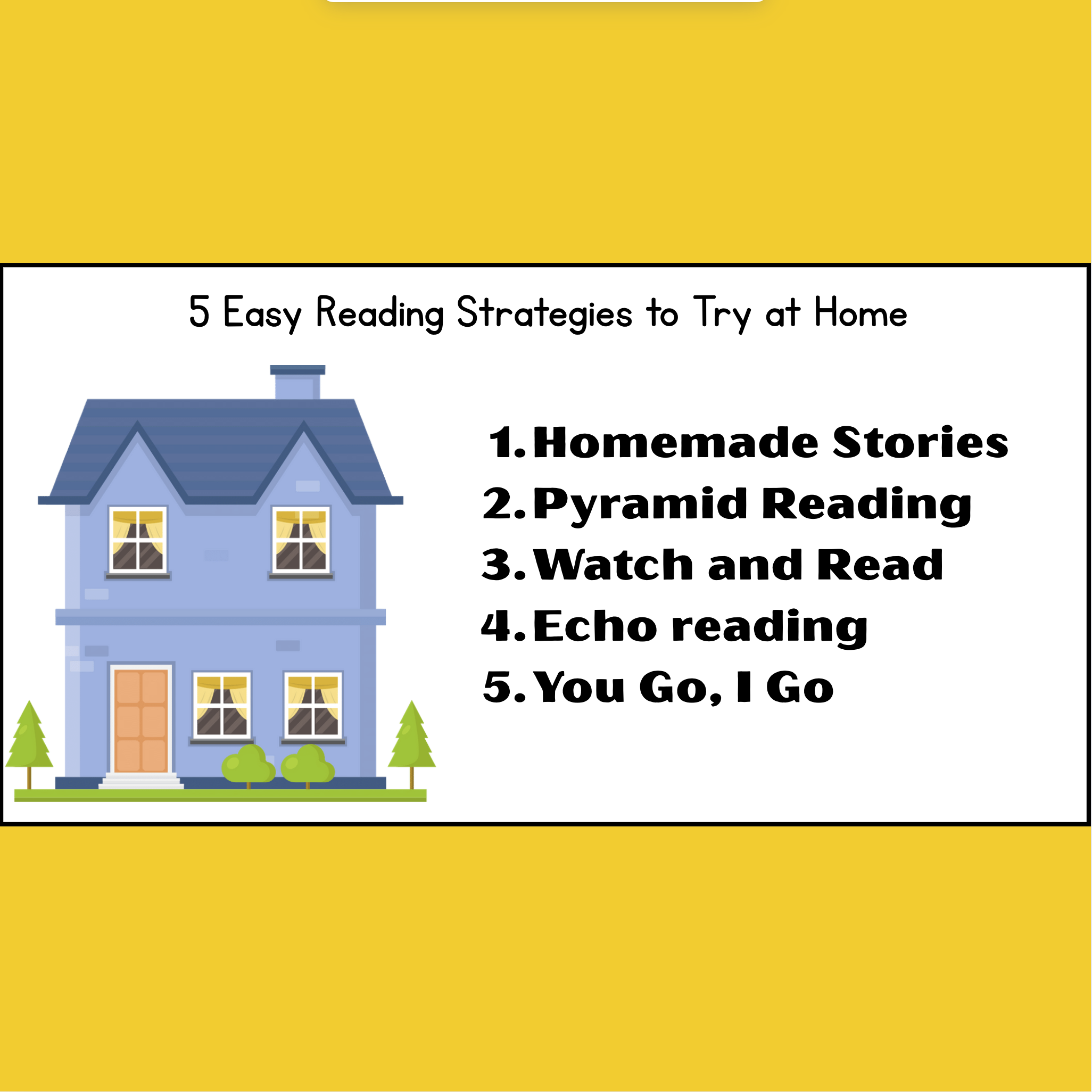
5 Easy Reading Strategies to Try at Home
1. Homemade Stories
Start small with personal stories about topics important to your child.

- You do not need to go out and buy a bunch of books to practice reading with your child. Keep a notebook where you can neatly write down short stories you create with your child about topics he/she cares about. Start by writing only one sentence per line. Only write on one side of the page. Let your child draw a picture on the opposite side.
Homemade stories connect reading and writing to your child’s lived experiences and personal interests.
2. Pyramid Reading

- As you can see from the example, pyramid reading builds a complete sentence as you move down the page. This gives the child an opportunity to practice pacing and expression.
3. Watch and Read
Little Fox is one of many great resources on YouTube that provides fun animated stories that appeal to kids in grades K-4. Have your child watch the video first then replay it on mute. Let your child read the story, pausing the video when necessary.
4. Echo/Repeated Reading
Echo reading is when the adult reads first and then the child reads the exact same text.
5. You Go, I Go: Taking Turns
There are many ways to take turns while reading. Perhaps your child reads one sentence and then you read the next sentence. As your child builds stamina, it is easy to bump up the challenge. One sentence become two, two sentences become a full paragraph, a full paragraph becomes a full page, a full page become an entire chapter and so on.

- Some kids like to underline the sentences they are responsible for reading.
- Take turns reading one paragraph at a time.

