Category: Reading

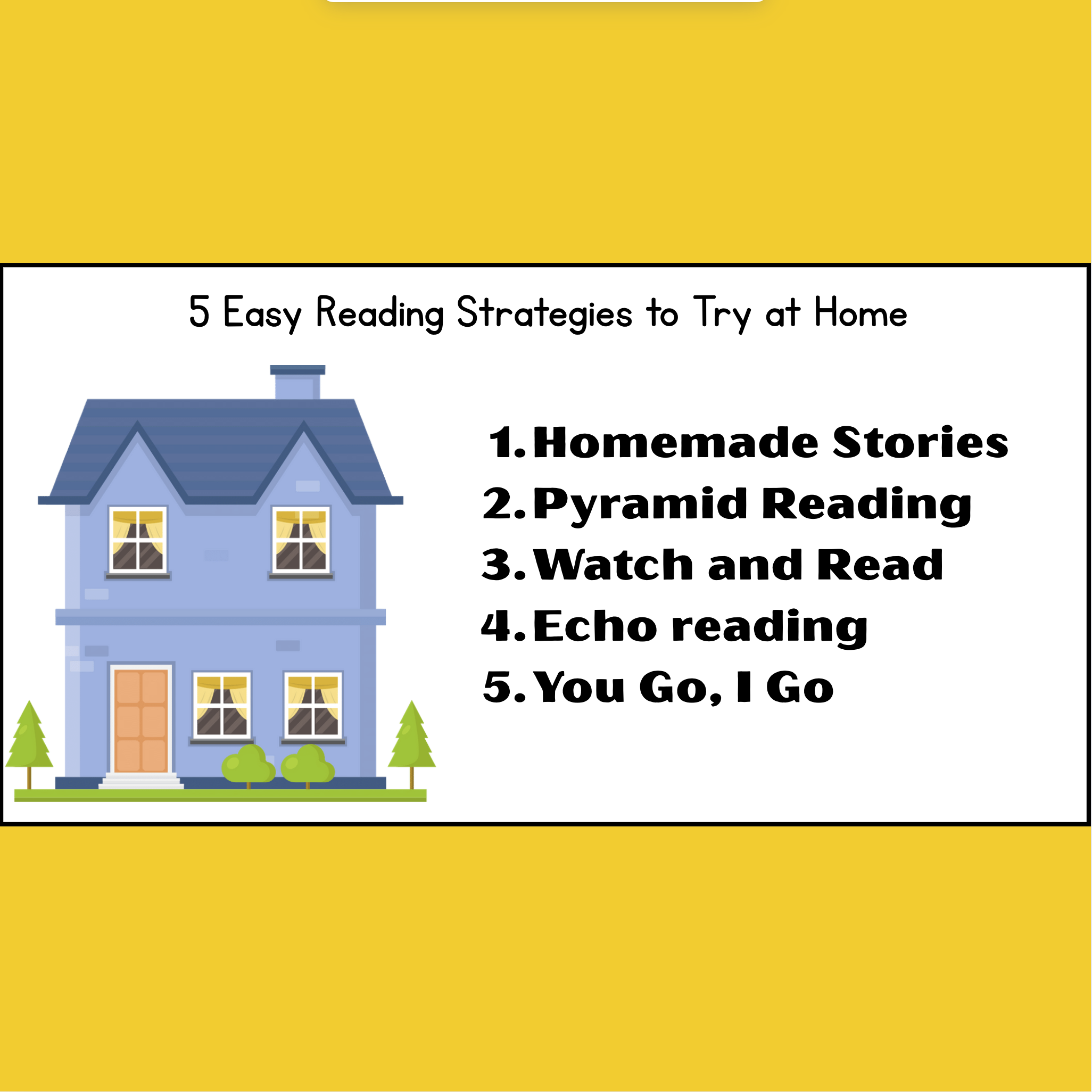
  • 5 Easy Reading Strategies to Try at Home

    5 Easy Reading Strategies to Try at Home

    1. Homemade Stories

    Start small with personal stories about topics important to your child.

    • You do not need to go out and buy a bunch of books to practice reading with your child. Keep a notebook where you can neatly write down short stories you create with your child about topics he/she cares about. Start by writing only one sentence per line. Only write on one side of the page. Let your child draw a picture on the opposite side.

    Homemade stories connect reading and writing to your child’s lived experiences and personal interests.


    2. Pyramid Reading

    • As you can see from the example, pyramid reading builds a complete sentence as you move down the page. This gives the child an opportunity to practice pacing and expression.

    3. Watch and Read

    Little Fox is one of many great resources on YouTube that provides fun animated stories that appeal to kids in grades K-4. Have your child watch the video first then replay it on mute. Let your child read the story, pausing the video when necessary.


    4. Echo/Repeated Reading

    Echo reading is when the adult reads first and then the child reads the exact same text.


    5. You Go, I Go: Taking Turns

    There are many ways to take turns while reading. Perhaps your child reads one sentence and then you read the next sentence. As your child builds stamina, it is easy to bump up the challenge. One sentence become two, two sentences become a full paragraph, a full paragraph becomes a full page, a full page become an entire chapter and so on.

    • Some kids like to underline the sentences they are responsible for reading.
    • Take turns reading one paragraph at a time.

  • Learn to Read and Spell: A Guide for Parents Who Want to Help

    Learn to Read and Spell: A Guide for Parents Who Want to Help

    • Does your child want to learn to read? Is your child struggling to learn to read? This post is dedicated to parents of little ones just starting their reading journey and to the parents of older kids who struggle to read and/or spell.

    Learn to Read: Step One:

    I want to help my child learn to read and learn to spell. Where do I start?

    • Learning to read and spell starts with the most important word in your child’s vocabulary: his or her name!

    Yes: Go to number 2.

    No: Start with Name Games

    • Check out the post below for some fun ways to help your child learn to recognize and spell his or her name.


    Step 2:

    My child can recognize and spell his/her name. What is next?

    • After your child has mastered his/her name, it is time to learn to read and spell with short vowel sounds.

    Yes: Go to number 3.

    No: Start with short vowel lessons:

    • Below is a link to short vowel songs, stories and activities.

    Step 3:

    Short vowel sounds are easy, now what?

    • Once your child has the hang of short vowel sounds it is time to help your child learn to read and spell with word families. Word families include vowels and consonants.

    Yes: Go to number 4.

    No: Start with Letter sounds and Word Families:

    • Letter Sounds:
    • Below is a link to word family songs, stories and activities.

    Step 4:

    Basic word families are a cinch. Now what?

    • The next skill to address is one syllable short vowel words. Help your child learn to read and spell with CVC words. After practicing 2 letter word families, it’s time to put those word families into longer words.

    Yes: Go to number 5

    No: Work on word families:


    Step 5:

    My kid can read CVC words. What is the next challenge?

    • Hopefully your child is becoming a more confidant reader. Now is the time to help your child learn to read and spell with long vowel spelling patterns. Recognizing long vowel spelling patterns is key to accurate reading and spelling.

    Yes: Go to number 6.

    No: Work on long vowel spelling patterns.

    • Below are links to songs, stories, and activities for A, E, I, O and U.

    Vowel A: https://thevowelcoach.com/how-to-teach-long-vowel-a-different-ways-vowel-a-can-spell-its-name/

    Vowel E: https://thevowelcoach.com/how-to-teach-long-vowel-e-different-ways-vowel-e-can-spell-its-name/

    Vowel I: https://thevowelcoach.com/how-to-teach-long-vowel-i/

    Vowel O: https://thevowelcoach.com/how-to-teach-long-vowel-o/

    Vowel U: https://thevowelcoach.com/how-to-teach-long-vowel-u/


    Step 6:

    We’ve got long vowel spelling patterns down pat. Tell me the next step.

    • Reading long vowel spelling patterns is great. Now Help your child learn to read and spell by practicing writing words with long vowel spelling patterns.

    Yes: Go to number 7.

    No: Work on sound boxes.

    • Below is a link to sound box lessons:

    Step 7:

    My kid understands long vowel patterns, but his/her spelling still needs help. Now what?

    • The Golden Rule of Spelling is that every syllable in every word has to have at least one vowel. This skill deserves a lot of attention.

    Yes: Go to number 8.

    No: Work on syllables.

    • Below is a link to syllable activities:

    My kid is doing great!